
Linear momentum is the product of the mass and velocity of an object:
$$ \begin{equation}\begin{aligned} momentum &= mass \times velocity\\ p &= m \times v\\ \end{aligned}\end{equation} $$The SI unit for linear momentum is: $$ \begin{equation}\begin{aligned} p &= m \times v\\ &\rightarrow kg\times ms^{-1}\\ &=kgms^{-1}\\ \end{aligned}\end{equation} $$
Example
Find the momentum of a car of mass $1000kg$ moving at a velocity of $4 ms^{-1}$ north. $$ \begin{equation}\begin{aligned} p &= m \times v\\ &= 1000kg \times 4ms^{-1}\\ &= 4000kgms^{-1}\\ \end{aligned}\end{equation} $$
Law of conservation of linear momentum
For an isolated system, the total momentum of the system before collision is equal to the total momentum of the system after collision.
This concept can be seen in Newton’s Cradle:
Click/tap here to load video
For the collision between two bodies with masses $m_1$ and $m_2$: $$ \begin{equation}\begin{aligned} total\ momentum\ before&=total\ momentum\ after\\ m_1v_1+m_2v_2&=m_1v_3+m_2v_4\\ \end{aligned}\end{equation} $$
Where $v_1$ and $v_2$ are the initial velocities and $v_3$ and $v_4$ are the final velocities of $m_1$ and $m_2$ respectively.
Example 1
A stationary ball B mass $5\ kg$ is struck by another ball A of mass $2\ kg$ moving at $4\ ms^{-1}$. Find the final velocity of B if Ball A continues in the same direction as ball B but with velocity $1\ ms^{-1}$.
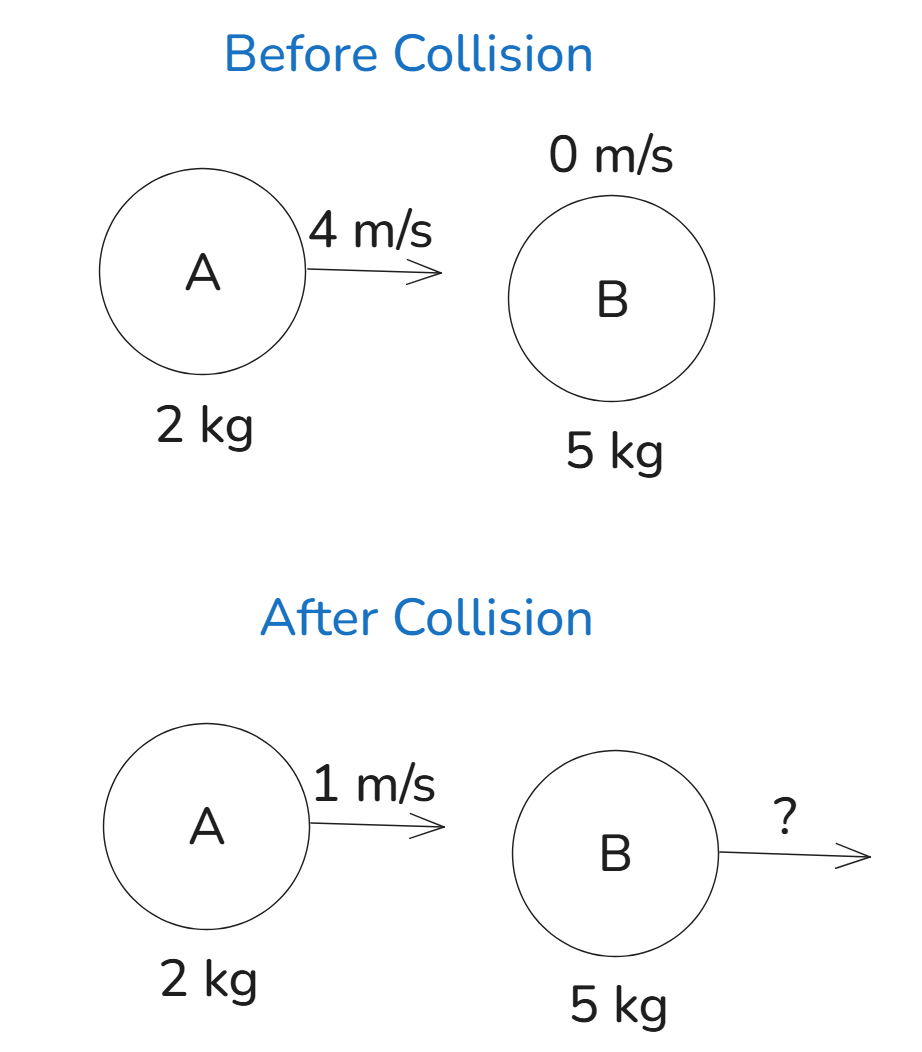

What we have:
- $m_1=2kg$
- $m_2=5kg$
- $v_1=4ms^{-1}$
- $v_2=0ms^{-1}$
- $v_3=1ms^{-1}$
- $v_4=?$
Example 2
Find the final velocity of B if Ball A is brought to rest by the collision.
What we have:
- $m_1=2kg$
- $m_2=5kg$
- $v_1=4ms^{-1}$
- $v_2=0ms^{-1}$
- $v_3=0ms^{-1}$
- $v_4=?$
Example 3
Find the final velocity of B if Ball A rebounds in the opposite direction with a velocity of $2\ ms^{-1}$.
What we have:
- $m_1=2kg$
- $m_2=5kg$
- $v_1=4ms^{-1}$
- $v_2=0ms^{-1}$
- $v_3=-2ms^{-1}$
- $v_4=?$
Example 4
Ball C with mass $4\ kg$ moving left at $5\ ms^{-1}$ collides with ball D mass $2\ kg$ moving right at $8\ ms^{-1}$. What is the final velocity of C if D rebounds left with velocity $4\ ms^{-1}$?
Example 5
A bullet of mass $20\ g$ is fired from a gun with a muzzle velocity of $100\ ms^{-1}$. The mass of the gun is $5\ kg$. Find the recoil velocity of the gun.
Elasticity and conservation of momentum
A collision is elastic when the total kinetic energy before the collision is equal to the total kinetic energy after the collision: $$ \begin{equation}\begin{aligned} \sum KE_{initial}=\sum KE_{final}\\ \end{aligned}\end{equation} $$
Regardless of if the collision is elastic or inelastic, the total momentum is always conserved. Conservation of momentum is therefore independent of elasticity.
Consider example 5:
A bullet of mass $20\ g$ is fired from a gun with a muzzle velocity of $100\ ms^{-1}$. The mass of the gun is $5\ kg$. Find the recoil velocity of the gun.
We already know that the momentum is conserved through the recoil of the gun. What is not confirmed is the conservation of kinetic energy in the collision. Let’s calculate the total KE before and after:
$$ \begin{equation}\begin{aligned} \sum KE_{before}&=\frac{1}{2}mv_{bullet}^2+\frac{1}{2}mv_{gun}^2\\ &=\frac{1}{2}(0.02 kg)(0 ms^{-1})^2+\frac{1}{2}(5 kg)(0 ms^{-1})^2\\ &=0J\\ \sum KE_{after}&=\frac{1}{2}mv_{bullet}^2+\frac{1}{2}mv_{gun}^2\\ &=\frac{1}{2}(0.02 kg)(100 ms^{-1})^2+\frac{1}{2}(5 kg)(-0.4 ms^{-1})^2\\ &=100.4 J\\ \end{aligned}\end{equation} $$Clearly the kinetic energy is not conserved, making the collision an inelastic one.
Created using natural intelligence