
Consider the area that is bounded vertically by a curve $y=f(x)$ and the x-axis, and horizontally by the lines $x=a$ and $x=b$:
This enclosed area is given by the definite integral: $$ \begin{equation}\begin{aligned} A=\int_a^bf(x)dx\\ \end{aligned}\end{equation} $$
The definite integral is the result of evaluation the integral considering two boundaries, in this case the lines $x=a$ and $x=b$.
Area trapped between two curves
In order to find the area, we need to determine the boundaries by finding the intersection of the curves. We then find, in the case of area relative to the x-axis, the integral of the difference between the upper curve and the lower curve.
Example
Find the area bounded by the two curves $y=x$ and $y=x^2$.
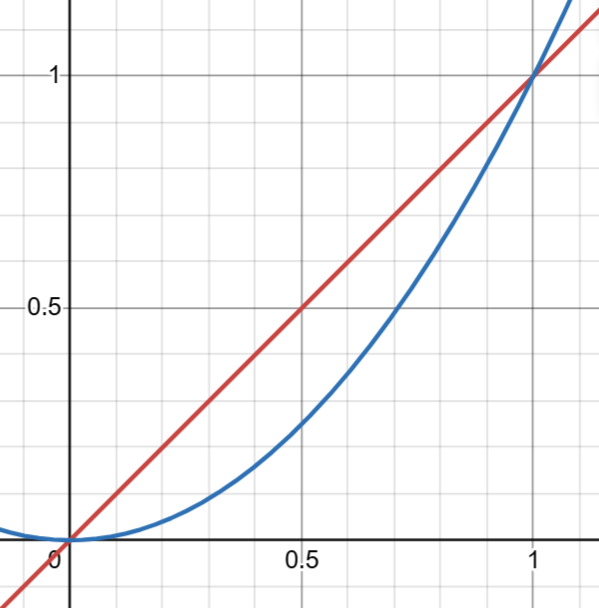
Solution We determine the intersections of the curves by solving them simultaneously: $$ \begin{equation}\begin{aligned} x&=x^2\\ 0&=x^2-x\\ 0&=x(x-1)\\ \therefore x=0&\text{ and }x=1\\ \end{aligned}\end{equation} $$
Because the curve $y=x$ is above $y=x^2$, we evaluate: $$ \begin{equation}\begin{aligned} A&=\int^1_0 (x-x^2)dx\\ &=\left[ \frac{x^2}{2}-\frac{x^3}{3} \right]_0^1\\ &=\left[ \frac{1^2}{2}-\frac{1^3}{3} \right]-\left[ \frac{0^2}{2}-\frac{0^3}{3} \right]\\ &=\frac{1}{6} \text{units}^2\\ \end{aligned}\end{equation} $$
Created using natural intelligence